Red Flags in a Fragrance Supplier's First Responses to a Brief
The first reply to a fragrance brief tells an established beauty brand more than a factory tour usually does. A supplier that answers with a catalogue and a price band has not yet begun to think about your product, while a supplier that answers with three questions about dosage, packaging and target shelf life has already started the project. The warning signs are almost never dramatic; they are small asymmetries in how much technical work the supplier invests before there is any money on the table. This article turns those asymmetries into a short, usable audit.
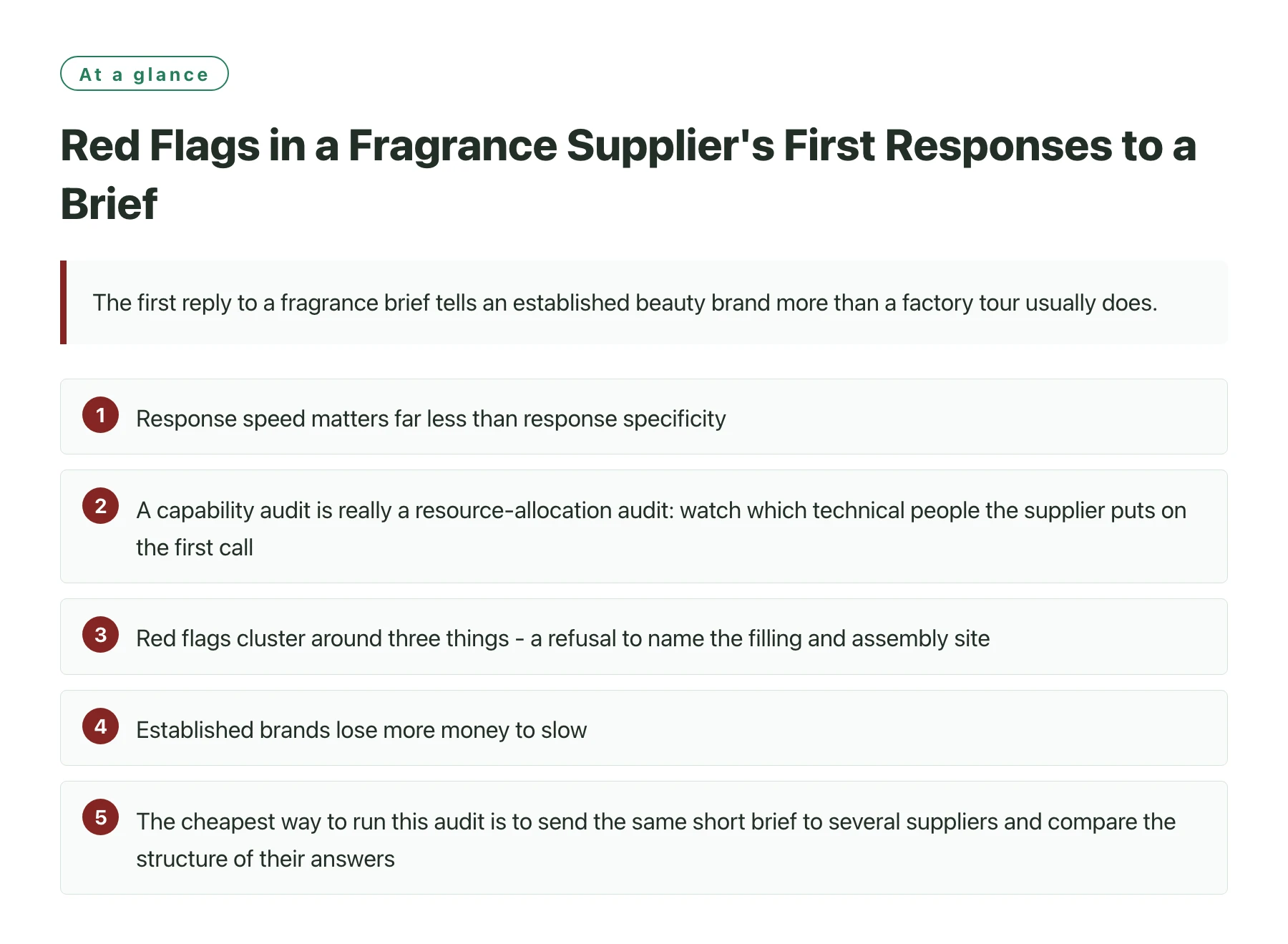
Key takeawaysResponse speed matters far less than response specificity, and the strongest early signal is whether the supplier treats the reply as a costing exercise or as a technical one. A reply that names materials, dosage ranges and a proposed filling format has been worked on by someone who expects to run the project later, and that expectation is what an established beauty brand should be buying. [1] · A capability audit is really a resource-allocation audit: watch which technical people the supplier puts on the first call, because that choice predicts how the project will be staffed six months later. · Red flags cluster around three things - a refusal to name the filling and assembly site, an inability to describe what happens between sample approval and bulk, and compliance language that stays vague about which standard applies to which product category. · Established brands lose more money to slow, polite, low-information suppliers than to suppliers that are openly small; small plus transparent is often a better starting position than large plus opaque. A manufacturer with visible production scope gives you something concrete to compare against. [2] · The cheapest way to run this audit is to send the same short brief to several suppliers and compare the structure of their answers, not the polish of their documents. · Vague answers are worth challenging once; a supplier that upgrades its answer when pushed is doing technical work, and one that restates the same marketing sentence is not.
Established beauty brands rarely fail to audit a supplier. What they fail to do is audit early enough to matter. Formal evaluations tend to happen after shortlisting, after sampling, after the commercial conversation has picked up momentum, which is precisely when a buyer is least willing to walk away.
The response phase is different because almost nothing is committed yet. A brief goes out, replies come in, and every reply is an unguarded sample of how the supplier works. This is not about catching dishonest factories. Most suppliers are honest and simply vary in depth, and the audit is designed to tell depth apart from presentation.
What an evaluation form measures, and what it misses
A standard supplier questionnaire collects company data: certifications, years in business, categories served, export markets. That information is useful for screening, but it is identical in structure for every supplier and therefore says little about the specific project in front of you.
What the form cannot measure is how the supplier allocates attention. Somebody at the factory had to decide whether the reply would be handled by a sales coordinator, a project manager, or a technical lead. That decision is the first real signal. When an established brand sends a brief for a fine fragrance with a defined alcohol base and receives an answer from someone who can discuss the dosage of a specific accord, the supplier has already spent money on the relationship.
Six warning signs, and the evidence that resolves each one
| What you observe in the reply | What it usually means | What to ask for next |
|---|---|---|
| Price band quoted with no reference to the fragrance load | Costing is being run from a generic template rather than from your formula direction | A cost breakdown that separates juice, bottle, pump, decoration and filling |
| No mention of where filling and assembly happen | The supplier may be a trading layer over one or more third-party sites | The name and location of the filling site, plus who holds the batch record |
| Certificates sent as a bundle of images | Compliance is being used as decoration rather than mapped to the product category | A mapping of each certificate to the process step it governs |
| Sample lead time given as a single number with no conditions | The supplier has a stock library in mind, not a development path | A sample plan that separates library trial, modification rounds and stability work |
| Technical questions answered with reassurance rather than detail | Technical review did not happen before the reply went out | A written answer to one specific question you already know the answer to |
| Everything is answered instantly and equally well | The reply is templated, and the real capability has not been tested yet | A short technical call with the person who would run the project |
None of these observations is conclusive on its own. The pattern matters: two or three together move a supplier from shortlist to watchlist, and the remedy is always the same - ask for evidence that costs the supplier a little work.
Three questions that do the work of an audit
- Ask which materials the brief rules outA concrete answer references specific restricted or hard-to-source materials and the alternatives that are typically substituted, which is how an ingredient-compliance conversation should sound.
- Ask what happens between approval and bulkRequest a one-page sequence with owners and durations. A supplier unable to write that sequence has never been close to a production handover, however long the client list is. [2]
- Ask who signs the batch recordThe role responsible for releasing bulk tells you where quality sits in the organisation. If the answer is a sales contact, quality is not a function the buyer can rely on.
Send the same brief, with the same questions, to every shortlisted supplier, then compare the structure of the replies side by side. Depth shows up as structure long before it shows up in a quotation. Benchmark against how the perfume factory in Guangzhou describes its own production scope, then decide what a good answer should look like before you shortlist anyone. If a reply is thin, ask once more with a specific technical question; abandoning a genuinely capable supplier over one template response is a real cost. Where the answer stays thin, the supplier is selling rather than planning.
Signs that are usually not warning signs
A catalogue-first reply
Suppliers with a deep stock library often open with it because most inbound briefs are library-led. Treat it as a default before a brief has landed, not as evidence of a limited capability. Compare what arrives in round two.
A request for more time
A factory that asks for two days to cost a formula properly is doing work. Instant and confident numbers are cheaper to produce than accurate ones and tend to be revised later, usually after the buyer has invested in packaging artwork.
A short export list
Export experience is category-specific. A supplier that has shipped home fragrance but not fine fragrance may still be the better partner for your project, provided the regulatory path for your destination is discussed openly rather than assumed.
A cautious compliance answer
Overstated compliance is the bigger risk. A supplier who says the standard applies to some items in the range and not others has probably read it, and a precise scope statement is easier to verify than a broad claim.
Recording the audit so it survives the shortlist
Keep the briefs and replies in one file per supplier, and score the six observations against evidence rather than impressions. A simple two-column log of what the supplier claimed and what it subsequently sent is enough; the moment a claim has no matching document beside it, the gap becomes visible to everyone on the buying side, not just the person who ran the audit.
Manufacturers that support both OEM and ODM routes usually ask more upstream questions - who owns the formula, who holds the mould, who approves the artwork - and those questions are themselves a useful cross-check on your own brief. Working with a manufacturer that supports OEM and ODM means the answers to those questions have to be settled before sampling rather than after.
The point of the exercise is not to disqualify factories. It is to decide, with evidence, how much supervision your team will need to budget for, and to reach that decision while walking away is still cheap.
Sources
- IFRA Standards Library (International Fragrance Association) —— The IFRA Standards Library lists the restrictions the fragrance industry applies to individual fragrance ingredients, based on safety assessments; it is the reference point for compliant fragrance formulation.
- SGS: Cosmetics, Personal Care & Household Testing —— Testing, inspection and certification services for cosmetics and personal care, including microbiological, stability and safety testing aligned with cosmetics GMP.
Frequently asked questions
What is the single clearest red flag in a fragrance supplier's first reply?
A refusal or inability to say where filling and assembly physically happen. Filling determines the batch record, the fill-weight control and the site that will answer for a defect, so a supplier that stays vague on this point is either a broker or has not yet mapped the production route for your product.
How long should a capability audit take for an established brand?
Two to four weeks from first brief to signed-off supplier, assuming your brief is complete. Most of that time is spent waiting for costing and sample plans, not in analysis. Compressing it below two weeks usually means skipping evidence collection and falling back on impressions.
Do we need to visit the factory to run this audit?
No. A visit is useful, but it comes after the response-phase audit, not instead of it. Everything in the six-point table can be checked from written answers plus two short calls, and doing it first means the visit is spent on open questions instead of introductions.
Can a supplier pass this audit and still fail in production?
Yes. This audit tests capability and candour, not execution. Production risk lives in details that only appear at volume: fill-weight drift, decoration tolerance, hot-cold cycling and how the supplier treats a deviation. Add a scale-up review and a documented pre-shipment inspection before you release the bulk order.
How should we handle a supplier whose reply is thin but whose factory reference is strong?
Ask one specific technical question and watch how the answer changes. If a technical lead appears and the reply gains structure, the thin first response was a coordination artefact. If the second reply restates the first, you are dealing with a sales process with no technical depth behind it.