From Quote to Delivery: Comparing hotel lighting suppliers
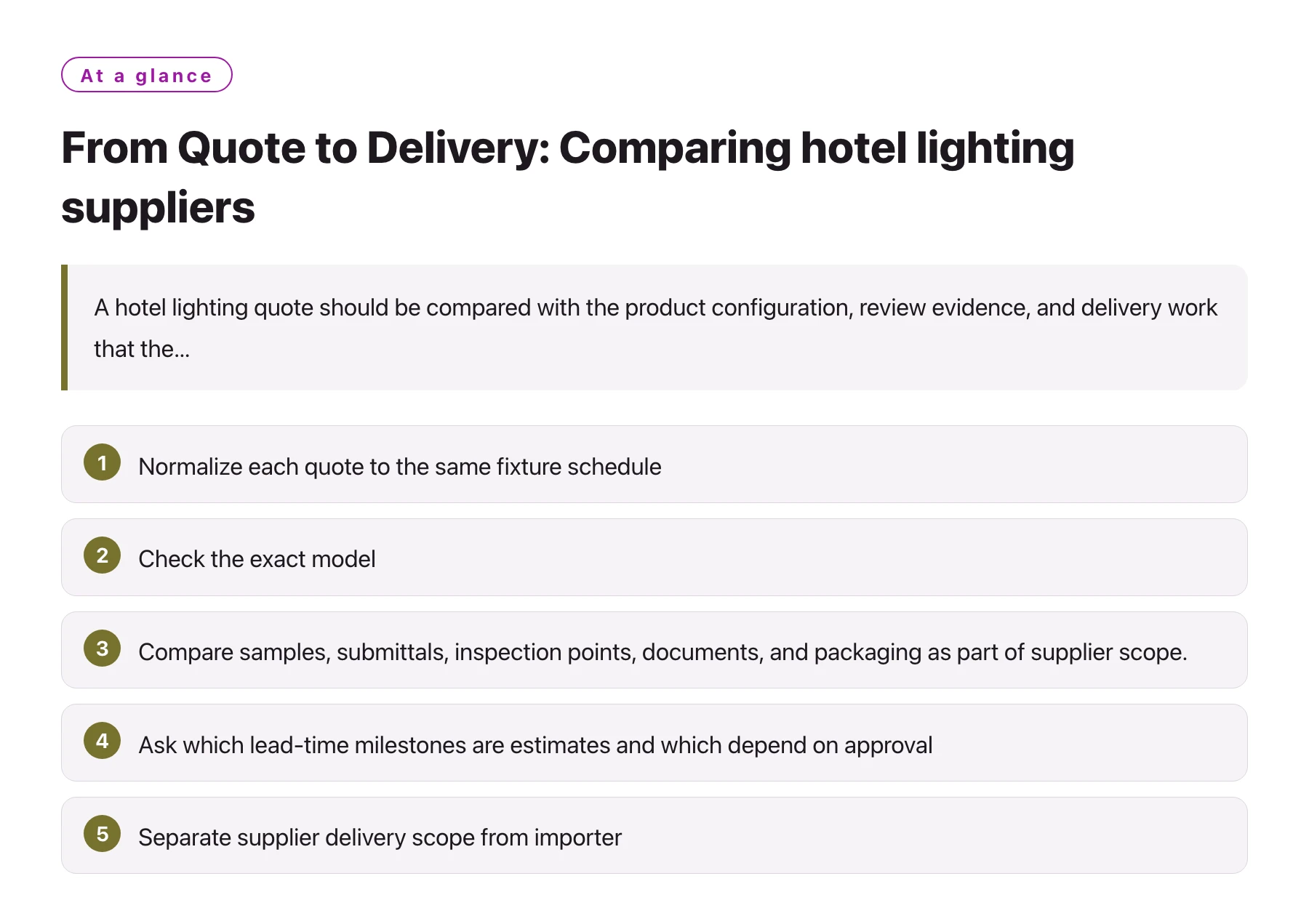
A hotel lighting quote should be compared with the product configuration, review evidence, and delivery work that the project will actually receive. Two suppliers can quote similar fixture names while offering different drivers, optics, finishes, controls, documents, packing, or shipment scope. A quote-to-delivery review makes those differences visible and assigns a reviewer to each decision before a purchase order turns assumptions into commitments.
Key takeaways
- Normalize each quote to the same fixture schedule, quantities, revision, and required options.
- Check the exact model, driver, optics, finish, controls, accessories, and stated deviations.
- Compare samples, submittals, inspection points, documents, and packaging as part of supplier scope.
- Ask which lead-time milestones are estimates and which depend on approval, material, or booking cutoffs.
- Separate supplier delivery scope from importer, customs, site receiving, and installation responsibilities.
- Record the decision rationale, open items, and release authority before production begins.
The lowest line on a quotation may not represent the lowest total effort or the product the design team approved. A complete comparison follows each offer from its technical assumptions through sampling, production, documentation, shipping, and site handoff. That lets the project compare the real package each supplier proposes rather than relying on similar wording in the product description.
Start with a line-by-line configuration comparison
Give each supplier the same fixture schedule and ask them to return an item-by-item response. For each type, record model number, quantity, dimensions, mounting, finish, source and driver, optics, CCT and color-rendering data where specified, dimming or control method, emergency options, and accessories. Require suppliers to mark a line as compliant, alternative, excluded, or requiring clarification, and to identify the evidence behind the response.
Compare drawings and data at the exact configuration level. A family brochure may show a range of options that are not all included in the quote. Check whether the offered driver, lens, finish, trim, wiring, and control components match the product schedule. If a model number groups several variants, request a configuration table or revised quotation that uniquely identifies the selected combination.
Keep deviations visible beside the affected schedule item. A proposed substitute can change appearance, output, glare, dimming, control compatibility, maintenance, electrical review, or delivery. Have the appropriate design and technical reviewers determine whether the product remains acceptable before considering it commercially equivalent.
Normalize commercial scope and exclusions
Check whether quotes include samples, custom tooling, finish setup, drawings, photometric files, testing, certificates, spare parts, installation instructions, packaging, export preparation, inspection, and delivery. Ask suppliers to identify the boundary of their price: factory pickup, a consolidation point, a port, an overseas warehouse, or a project site. If the scope differs, add the missing work to the comparison or label it as unresolved.
Record currency, validity period, payment schedule, minimum quantity, production assumptions, and the events that may change the cost. Ask whether a quotation depends on a specific room count, production batch, material availability, or consolidated order. If the supplier lists a freight estimate, clarify whether it is binding, which services it covers, and which destination charges remain open.
Include the buyer's coordination effort in the decision. A quote that excludes sample shipping, inspection scheduling, document correction, or site labeling may require internal time or another service provider. The project can still select it, but the cost and ownership should be visible rather than discovered after the purchase.
Compare sample and submittal commitments
Ask when a supplier can provide a finish sample, powered fixture, or mock-up and what the sample will represent. Record model, finish, driver, optics, controls, date, and drawing revision. A sample made with temporary components may help review appearance but cannot demonstrate the final control or electrical configuration. State what the sample approval will cover and what still requires technical review.
Request a document index that lists submittal title, product or model covered, revision, issuing party, due date, and review status. Compare the quote's documentation promise with project requirements. If a datasheet or report covers a product family, ask the supplier to identify where the offered variant falls within that family and whether the evidence remains applicable after a substitution.
Name separate approvers for design appearance, controls, electrical details, destination documents, and production release. A design approval does not automatically clear every open technical or compliance item unless the project explicitly says so.
Read the proposed schedule as a dependency chain
Ask the supplier to identify the events behind its lead time: drawing approval, sample sign-off, long-lead components, production start, inspection, packing, pickup readiness, and dispatch. Distinguish calendar estimates from dates tied to a confirmed input or booking. Compare suppliers only after they use the same start point and delivery destination.
Link the supplier schedule to construction and room sequencing. Identify which fixture types must arrive first for installation or commissioning and which can be delivered later. Ask whether quantities can be split without changing unit pricing or packaging and what happens if a room count changes. A short factory lead time does not by itself ensure the goods reach the site at the required point in the build.
Define an update cadence and exception route. Ask the supplier to report a likely delay, component change, missed approval, or production issue with the affected item, quantity, new expected date, and next decision required. Assign someone on the buyer side who can answer or escalate each issue.
Compare inspection, packing, and receiving scope
Ask what pre-shipment checks are included and which characteristics they cover. Define inspection sample, acceptance limits, test conditions, records, and the person who may release goods. If the project needs a room-specific sample, custom fixture, or controls test, make sure the proposal states whether it is included or priced separately.
Compare packaging and labeling commitments. The site may need cartons by floor, room type, fixture code, or installation phase. Ask for package dimensions, weights, fragile-item protection, spare parts, and handling instructions. Confirm who creates labels, reconciles packing lists, books pickup, arranges consolidation, and reports visible damage or shortages at receipt.
When goods enter the United States, U.S. Customs and Border Protection's importer guidance discusses entry information and records importers should understand for a transaction.[1] Confirm the applicable obligations and documentation with the responsible importer or qualified broker; a lighting supplier's delivery quote may not include every customs or destination task.
Use a decision matrix that shows unresolved risk
Score only factors that matter to the project and record the evidence behind each score. Useful comparisons may include configuration fit, sample and document quality, change control, schedule assumptions, inspection scope, delivery boundary, cost, and communication ownership. A high total should not conceal a critical unresolved safety, compliance, installation, or design issue; treat those as approval gates.
Document the selected supplier, accepted deviations, open conditions, next milestones, decision owners, and evidence due before production or shipment. If the project chooses an option based on price or schedule despite a known trade-off, record the rationale and mitigation. This makes the decision understandable to the site and operations teams who inherit the order.
For teams sourcing Learn more about hotel lighting, compare the service scope against the tasks still owned by design, engineering, procurement, logistics, and the importer. Keep the final product requirements and acceptance authority explicit in the purchase documents.
Sources
Frequently asked questions
What is the first difference to check between hotel lighting quotes?
Confirm the exact model and configuration, including driver, optics, finish, controls, accessories, and exclusions. Similar product descriptions can conceal different options or delivery scope.
Should delivery charges be compared as one total?
Compare the included route and services, then list destination charges, customs work, storage, installation, and other exclusions separately. A single total is useful only when it covers the same endpoints and tasks.
Can a supplier's sample approve the full lighting package?
A sample can support decisions within its defined scope. Design appearance, technical submittals, controls, destination requirements, production configuration, and delivery release may require separate evidence and reviewers.
How should a buyer handle a lead-time difference between suppliers?
Compare the milestones and assumptions behind each estimate, connect them to project dependencies, and identify what approval or material event starts the schedule. Record the risk and the responsible escalation contact.