CrushOn.AI: How the Unfiltered Character Chat Platform Works
A new visitor lands on one navigable surface with three doors: Characters, Memories and Creators. Everything the platform does sits behind those three words, and the practical question is what a first session looks like in each of them. An illustrative profile of 30 messages a day comes to 900 messages a month, which is a useful scale for judging whether the structure fits how you actually chat.

Key takeaways
- Three entry points carry the whole product: Characters to browse and chat, Memories to hold threads together, Creators to follow the people publishing them.
- The unfiltered label sits alongside Filtered and 18+ filters rather than replacing them, so the catalogue can be narrowed before a single card is opened.
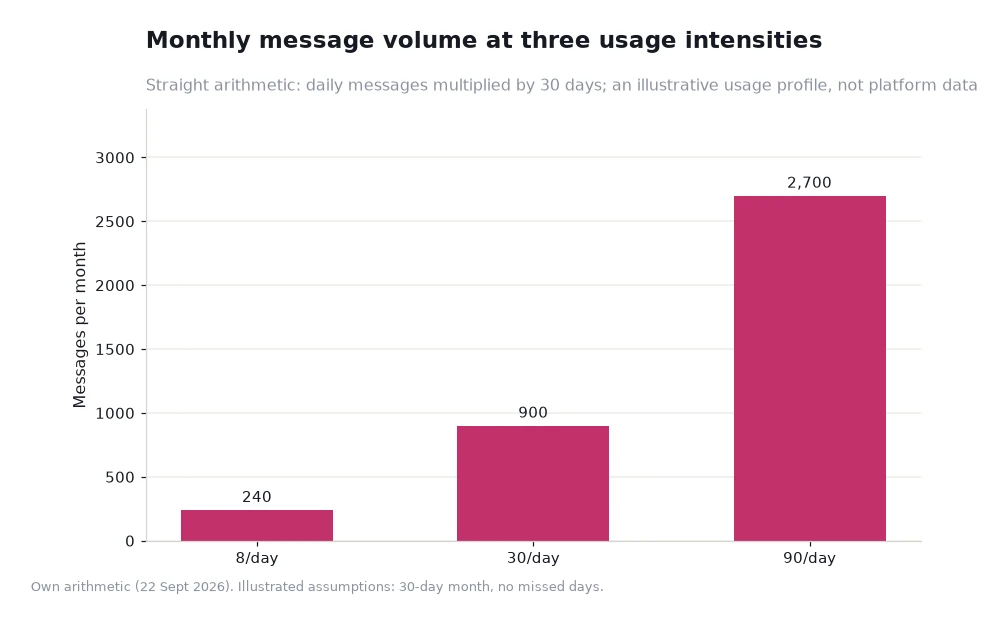
- Message volume scales linearly: an illustrative 8 a day is 240 a month, 30 a day is 900, and 90 a day is 2,700.
- The platform states that its content is AI-generated text and depicts no real person, which is the framing every expectation should start from.
What the first screen actually offers
The home view exposes navigation rather than a feed. Characters is the browsing surface, with sections such as Recent Hits and Animated sitting above a gender filter. The filter row adds Unfiltered, Filtered and 18+ as overlays, so the same catalogue can be viewed through a narrow or a broad lens without switching products.
Memories is the second door and the more interesting one for anyone who chats regularly. It is the part of the interface that keeps a running context for a conversation, and it is the reason a returning session does not begin from a blank slate. Practically, that means the value of the platform compounds with use in a way a one-off chat does not.
Creators is the third door, and it reframes the catalogue as authored work. Characters on the platform are published by people who write them, and the Creator view is where those authors can be followed. Anyone who has found one character they like will usually find the same author has written several more in a compatible register. You can start from the front door at https://crushon.ai/ and reach all three from the same header.
One habit makes the structure easier to learn: open the same listing twice on different days. The first visit is about reading a description and forming an impression. The second shows whether the thread resumed where it stopped, which is the clearest demonstration of what the Memories area is for. Two short visits on separate days teach a new account more about the product than a single long one, and they cost about ten minutes in total.
Why unfiltered is not unlimited
The marketing word is unfiltered, and on the Crushon platform it means the service does not impose a sanitised layer on adult roleplay. It does not mean there are no rules. The client's own FAQ states that some limitations apply in accordance with its content and community guidelines, and it publishes a content removal policy plus a separate complaints route for anyone who wants a listing reviewed. Read together, those documents are the honest description of the position: wide latitude for adults, with a formal process for the exceptions.
Two more pages make the boundaries explicit. The site carries an 18 U.S.C. §2257 compliance statement, last updated 8 February 2025, which states that the content is AI-generated text, does not depict real people, and that the service does not produce images or video. That statement answers the most common misconception about platforms in this category, and it is worth reading before forming expectations about what a "character" is here.
| Surface | What it holds | What it changes |
|---|---|---|
| Characters | Browsable listings with sections such as Recent Hits and Animated | Whether you arrive at a shortlist or a single listing |
| Memories | Running context for threads you return to | Whether session ten starts warmer than session one |
| Creators | Attribution for the people who publish characters | Whether you follow an author or keep re-searching |
| Filters | Unfiltered, Filtered and 18+ alongside a gender filter | How much of the catalogue reaches your shortlist |
| Policy pages | 2257 statement, content removal policy, complaints route | What you can ask the operator to review or remove |
Worked example
Take three illustrative intensities and multiply by a 30-day month. The arithmetic is deliberately plain, and it is an assumption set rather than platform data. Light use: 8 messages a day × 30 days = 240 messages a month. Regular use: 30 a day × 30 = 900. Heavy use: 90 a day × 30 = 2,700.
The ratios between those columns are the useful part. 900 is 3.75 times 240, and 2,700 is exactly three times 900. If a session averages around 25 seconds per message, the regular profile spends roughly 375 minutes a month inside the app, which is about 6.25 hours, and the heavy profile about 1,125 minutes, or 18.75 hours. Presenting it that way stops "unlimited" from meaning "unmeasured": the meter is your own time.
Subscribe level aside, the shape of the answer is the same for every new visitor. A light month of 240 messages is about 8 minutes a day at 25 seconds a message; a heavy month is more than an hour a day. That is the honest comparison to make before deciding how the app fits into a routine.
What to do in the first ten minutes
Open Characters, apply Unfiltered, and pick two listings rather than ten. Read the description as a statement of tone. Then start one thread and stay in it long enough to see whether the replies track what you have said — that is the behaviour the Memories area exists to support, and it is the difference between a catalogue of chatbots and a platform built for ongoing conversation.
Before you commit an evening to it, spend two minutes on the policy pages. The 2257 compliance statement tells you what the content is, the removal policy tells you what happens when a listing should not be there, and the ranking view shows what other people are choosing this week. Those three reads cost less time than a single long session and they set accurate expectations.
Frequently asked questions
Do I need an account to browse?
Browsing is the easy part; the meaningful parts of the product are conversational and tied to your own threads and memories, so treat signing in as the first real step.
What does the Memories section change?
It preserves context between sessions, so a continuing thread does not restart cold. The practical effect is that the tenth session can begin with shared history rather than introductions.
Who writes the characters?
They are published by Creators, and the platform shows attribution on the listings. Following an author whose register suits you is faster than filtering the whole catalogue again.
Start with structure, not volume
Pick the door that matches the session in front of you: browse under Characters, continue under Memories, and follow under Creators. That single habit replaces most of the trial and error a new account otherwise goes through.
Then set a personal meter in messages rather than in adjectives, and revisit it after a fortnight. The numbers are easy to read once you decide to look at them, and they are the only honest way to judge whether the platform is a small treat or an evening habit.
Data and sources: navigation, filters and policy pages of the CrushOn.AI platform[1], together with the character search view[2] and the weekly ranking view[3], read 22 Sept 2026. Message volumes and minutes are illustrative assumptions, not platform data. Written for adults aged 18 and over.